
Not All Audiences Are Created Equal
July 30, 2026
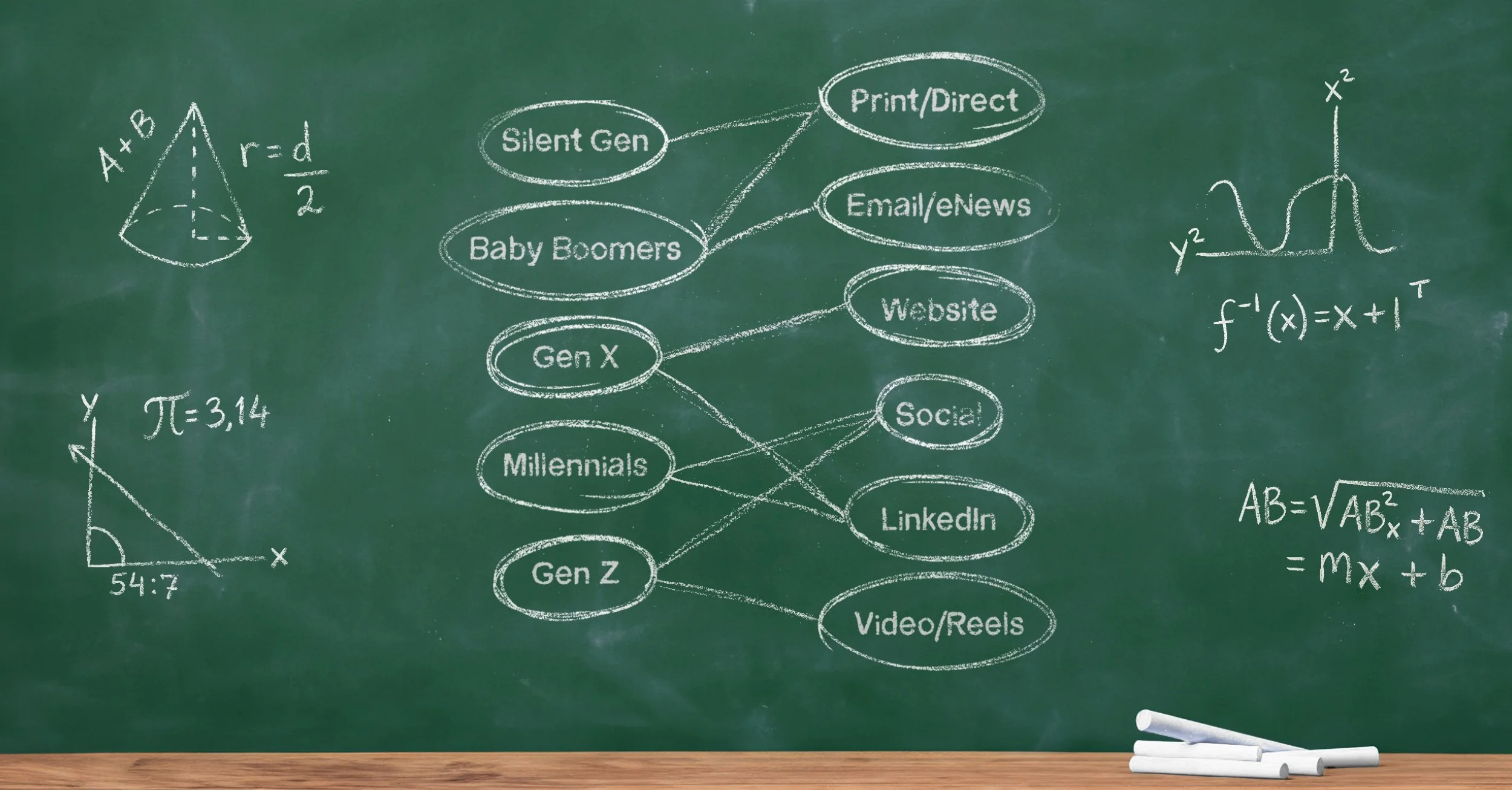
When designing campaigns, creating reports, or even crafting social media posts, communications professionals face complex calculations.
And they often find the math doesn’t work.
This is especially true at social good organizations, where their potential audience spans five generations across multiple segments, including colleagues, donors, prospects, professional advisors, grantees, partners, community members, and more.
The arithmetic becomes even more complex when you consider at least 15 channels are in play: blogs, broadcast, email, events, podcasts, print, radio, streaming, websites, video, and a half-dozen social platforms — LinkedIn, Bluesky, Facebook, Instagram, Snapchat, Threads, TikTok, X, YouTube — whose audiences barely overlap.
Five generations. At least six potential priority audience segments. Fifteen channels.
Viewed through a be-all-things-to-all-people mindset, this is often interpreted as a budget problem — if we only had more money, we could connect with all these audiences leveraging all these channels!
In reality, this is almost always an audience-prioritization challenge disguised in the budget-problem emperor’s clothes.
Yet, if you allow those clothes to fall to the floor, then your true challenge — and its corresponding solution — are laid bare.
Start by simplifying
The naked truth is you cannot convert donors or inspire people to support your cause if you don’t prioritize.
And that means zeroing in on your highest-priority audiences and developing a formula — and corresponding budget — that presents the best opportunity to deepen relationships and move those in the priority zone to engagement and action.
Through this exercise, you’ll likely limit the channels required to reach them, saving time and resources and improving effectiveness.
You can further refine your approach by creating compelling personas that define who these audiences are and their behaviors, attitudes, preferences, and values. From these personas, you can identify and leverage the nuances of connecting with key audiences in more consistent and authentic ways.
The combination of an actionable strategy and well-crafted personas allows you to shift from more generalized communications to real conversations and connections with the people who matter most to your mission.
That matters today more than ever, because while America is in the midst of an unprecedented transfer of wealth — leading to record-breaking charitable giving topping $617 billion in 2025 — the size of the donor base has been on a steady decline over the past five years, a trend expected to continue.
The bottom line: While there are more dollars earmarked for charitable giving, the pool of people giving is shrinking. That means if your story is not reaching the right people at the right time with the right message, you’re limiting opportunities for your organization to grow in service of your mission.
The compounding effect
By engaging in meaningful audience segmentation and developing accurate, actionable audience personas, a communications leader can operate from a position of confidence and true stewardship that concentrates finite resources where they will compound.
It builds the case for a budget ask that prioritizes audiences identified by factors such as what Pew Research Center describes as “shared formative experience” of a generational cohort and key segments such as professional advisors.
This is true stewardship because what you gain is not merely efficiency. You master the ability to track and measure progress and results.
A social good organization that funds a little of everything has few tangible results to point to a year later.
One that operates with disciplined audience focus can draw a direct line from communications and engagement to measurable results.
That’s the hypothesis, the data to back it, and a defensible case for the C-suite. And that all adds up to sustained success.