The AI Gap Is Real — and It's Going to Take the Entire Field to Close It
During a recent conversation, a database manager at a Midwestern community foundation voiced what a lot of people in her seat are thinking about AI.
"I feel like we're at zero, and this is jumping to a thousand," she said. "I'm facing folks who are very anti-AI, don't want anything to do with it in the office, and a couple people who maybe use ChatGPT. I'm the only one really pushing for this."
For nearly a year, as part of our work on the Community Foundation Alliance Infrastructure Fund, our team has met with dozens of CEOs, communications directors, finance and operations leaders, and program staff to understand how AI is landing inside their organizations.
The message has been consistent: Technology, especially AI, is producing a fast-moving and seemingly endless array of options, but internal constraints have made it impossible for them to put this technology to use.
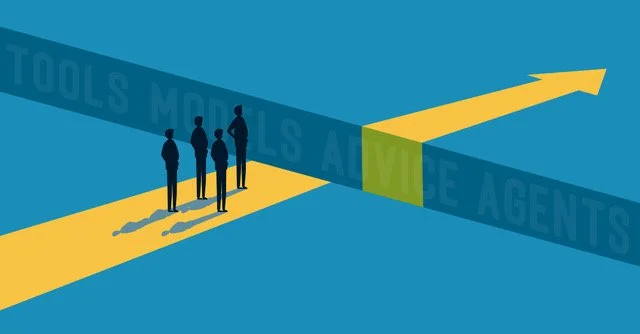
The gap is real
The supply of AI tools, models, agents, and advice grows every week, but few, if any, foundations or nonprofits have the capacity to evaluate, adopt, govern, and truly benefit from this explosion.
That mismatch shows up in a few ways.
The first is in the technology itself. One communications lead told us her foundation's AI policy requires staff to use licensed AI tools while blocking alternatives they find useful. Another said her IT department's restrictions on desktop software would block a tool we were demonstrating. Several foundations we talked to are in the middle of CRM migrations that consume every spare hour without a clear picture of the value they will bring.
Another mismatch can be found in workloads. This likely won’t surprise you: Nearly everyone we’ve spoken to said they and their colleagues are already working at or beyond capacity. The prospect of taking time to learn new skills or experiment with fast-moving technology is especially daunting when that time is already spoken for.
Finally, there’s culture. Most foundations and nonprofits are not built to be first adopters, and many have processes and policies created to minimize rather than encourage risk. What’s more, many we’ve spoken to have been scarred by tech upgrades and integrations that have swallowed capacity and failed to produce the desired results — or worse, they’ve created new problems, such as AI hallucinations that made their way into a report.
All of these barriers are structural and difficult to overcome. Organizations recognize the value of emerging technologies, but they don’t have the bandwidth or structure to embrace them.
What’s working?
The nonprofits and foundations making real progress have stopped trying to figure this out alone.
Three things separate them:
1. They co-create their principles and policies. The most common blocker we hear is "we need an AI policy first." One person spends months on it, and by the time it's finished, the technology has changed.
Here’s a better sequence: Start with a few principles, run some experiments, and document what you learn. Better still, do it with peers who share your values, so nobody is the sole author of a policy that’s outdated before it’s introduced.
2. They build avenues for shared learning. A finance VP told us how his foundation successfully navigated a recent CRM migration: by calling colleagues who had made the same move and comparing notes. The willingness to share, he said, is one of the things he's come to admire most about his peers.
That same instinct applies to AI. Someone at a peer foundation or nonprofit has likely already built a tool, agent, or use case that would be helpful for your organization and would happily share what they’ve learned.
3. They take control of their own journey. Organizations that feel overwhelmed are usually the ones waiting for answers to be presented to them.
The ones gaining ground start with a question: What can we build to accomplish what we want to achieve?
The answer may be a tool that helps you understand your grantmaking patterns, a donor-research assistant that respects your data policy, or a simple checklist that helps a two-person team produce an annual report. When the work starts from your priorities and stays under your governance, overload isn’t a problem because you're building tools that get you where you want to go.
Where this goes
The gap between what's available and what you can absorb is not going to magically close on its own. If anything, it widens every time a new model ships.
However, it closes quickly when foundations pool their learning, share their work, and own the infrastructure together. The challenge is finding the organizations that want to collaborate on this.
That's the premise behind the Community Foundation Alliance Infrastructure Fund, and it's what a founding group of foundations is beginning to test with us now.
The organizations finding value in AI aren’t trying to jump from zero to a thousand. They’re working together to build the platforms that can usher them across the gap.