
The Work Beneath the Budget
Summer’s unhurried days are winding down. After Labor Day, the same task awaits every communications leader in the social good sector: Build next year’s budget along with a plan that shows the value of the investment.
The season always arrives with equal parts dread and possibility. Dread because of the challenge of quantifying awareness. Possibility because the right combination of concept and execution makes the value easy to calculate.
Nobody had to explain the value of the Ice Bucket Challenge to the ALS Association's board. The $115 million raised by the 2014 campaign, compared to the $2.8 million raised over the same period the prior year, speaks for itself. So does the fact that millions of people learned about ALS — and the ALS Association — for the first time.
The ALS Association clearly caught lightning in a bottle. But it doesn’t take a lightning strike to demonstrate the value of awareness.
It does, however, take work. Fortunately, you don’t need to go it alone.
A proven template
The Public Relations Society of America (PRSA) and the Universal Accreditation Board have for decades taught a 10-step method for writing a comprehensive communications plan. Every step follows from research rather than instinct. And because it’s a recognized, proven methodology, it carries credibility with the CFO who might not readily see the potential of a “raise awareness” line item.
The amplifying power, though, isn’t in what a plan adds. It’s in what it removes. Discipline is an act of subtraction: eliminating activities that may feel productive but don’t advance to a measurable objective, until all that remains are the things that actually make a difference.
That’s how a plan becomes something tangible, actionable, and easy to share.
Creating the plan is step one. You then need to map out how to execute it. And what makes this framework so powerful is that it creates clear accountability. You identify who does what, by when, and present it in a way that everyone involved sees the dynamic value of their contributions while the work is happening.
A plan no one can see – or see themselves in – is a plan no one follows.
You also need to measure results against your plan. How far did you get? What did you accomplish? What did you learn that’s worth carrying into next year? That has to be concrete — metrics you identified before you started, not numbers you went looking for afterward to make the year look good.
Make the value clear
Your full plan may run dozens of pages. Its value shows up when you can capture it on one.
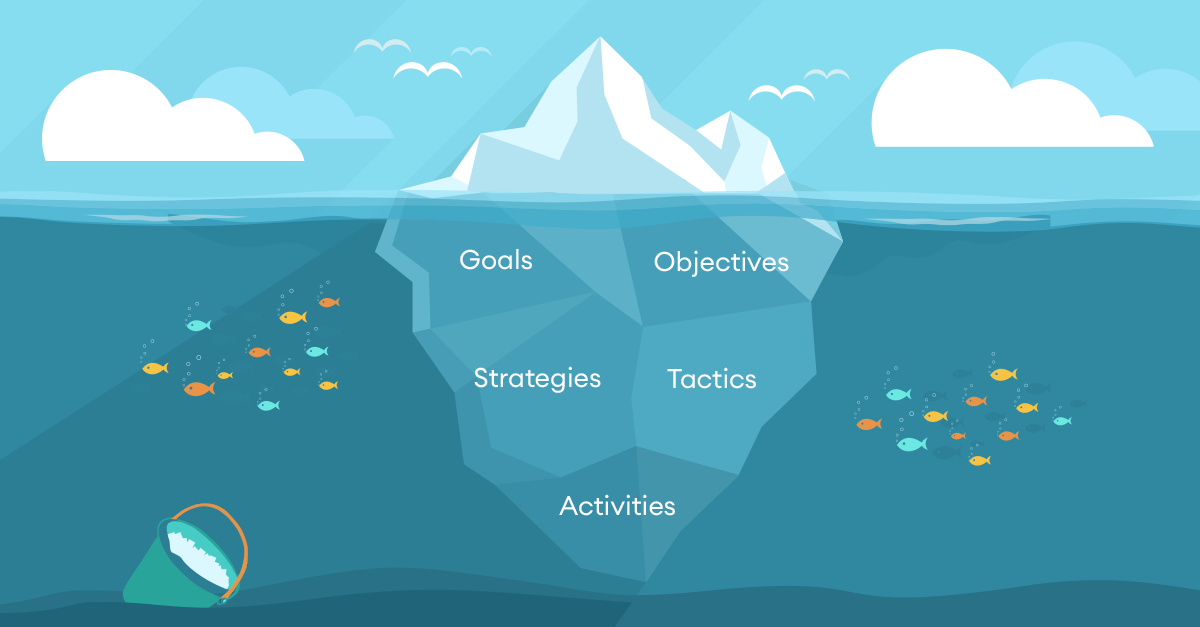
An annual plan on one page lets others see its potential. Here’s what needs to be on that page:
1. Goals that show what success looks like for your organization. For instance, our county will be the state’s standard for educating local families about how to access food assistance programs.
2. Objectives, measurable changes that build to the goals, such as a 25% increase in food assistance program applications by Sept. 30.
3. Strategies that can help accomplish the objectives. For example, reach community members via communications tactics at places they’re most likely to turn to for help (healthcare clinics, places of worship, schools).
4. Tactics that bring the strategies to life, such as partnering with 15 pediatric practices.
5. Activities that deliver the tactics. For instance, create a bilingual one-sheet with information about the program that's provided at every appointment during check-out.
Start at the top, because everything beneath the goal has to ladder up to it.
A plan on one page shows your executive team and your board the connection between the communications investment and organizational priorities. It keeps your team on target when everything urgent is trying to crowd out everything important. And at the end of the year, it’s what you measure results against.
The Ice Bucket Challenge created a clear connection between awareness and value. It led to a spike in donations that funded advancements in ALS research and improved access to care.
But you don’t need to create a viral sensation to make this connection. With a single page, you can show your board and C-suite what awareness requires and what it can deliver for your organization.
So let go of the dread. Enjoy the last barbecue of the summer, then get to work.
You know the potential. Now show everyone else what you see.
Learn more about the 10-step method, and for more social-good strategy and communications advice, check out our On Message blog.